You can tell within five minutes of stepping onto the wrong “waterfront” in Belize.
The view is perfect. The breeze is perfect. Then you ask one practical question: “Where do we keep the boat when the weather turns?” The answer is usually some version of “You’ll see.” In the Caribbean, that’s the moment where romance and risk collide.
If you’re searching for naturally protected waterfront property belize, you’re already asking the right question. You’re not just buying a view. You’re buying usable water, predictable access, and a setting that makes ownership simpler – for you, for renters, and for whoever buys from you later.
What “naturally protected” really means on the water
In real estate listings, “protected” gets tossed around the way “walkable” does in city markets. The difference is that on the water, protection has a price tag.
Naturally protected waterfront is about geography doing the heavy lifting. Instead of relying on expensive seawalls, dredging, or constant maintenance to keep your shoreline intact and your boat safe, the land itself provides a buffer: inland bays, mangrove edges, sheltered canals, leeward positioning, or a safe-harbor layout that reduces exposure.
That protection typically shows up in three real-life ways.
First, calmer water on normal days. Not flat like a pool, but less chop, less wake damage, and more comfortable small-boat travel. Second, better storm behavior. No site is “hurricane-proof,” and Belize can see serious systems. But there’s a big difference between being on open, wind-driven water and being tucked into a natural harbor where wave energy has already been broken up before it reaches your dock. Third, shoreline stability. Erosion is not theoretical. Over years, it can change the shape of a lot, the safety of a structure, and the cost to maintain a clean, swimmable edge.
Protection is not a luxury feature. It’s a risk reducer.
Why this matters more in Belize than most buyers expect
Belize is friendly to foreign buyers and famously easy to fall in love with. But that ease can trick people into thinking the coastline behaves the same everywhere.
It doesn’t.
Belize has a long, varied waterfront: barrier reef areas, river mouths, lagoons, open bays, and low-lying coastal plains. Water depth, bottom composition, and wind patterns can change dramatically within a short drive. A lot that feels like a dream at noon can become a headache at 6 pm when wind stacks waves into a narrow channel. And a home that looks “right on the water” can be functionally disconnected if the access route silts up or if shallow flats limit boating to high tide.
Naturally protected waterfront property tends to hold up better to the two things that quietly affect value over time: usability and insurability. Even if you don’t plan to insure every element of the property (some buyers self-insure certain risks), lenders, future buyers, and rental guests all respond to the same cues. They want a place that feels secure, not just scenic.
The trade-off: open-water drama vs. everyday use
Some buyers crave the cinematic version of waterfront: wide-open horizon, surf sounds, the sense that you’re perched on the edge of the world.
There’s nothing wrong with that – as long as you’re honest about the trade-offs.
Open-water frontage can mean stronger breezes, bigger sunsets, and that classic postcard look. It can also mean more corrosion, more salt spray, higher wear on docks, and more days where boating feels like a chore. If you’re planning to operate a vacation rental, those “chore days” matter. Guests don’t care that the ocean is dramatic if the paddleboards are useless or if the dock is unsafe in rough conditions.
Protected waterfront flips the script. You may trade a little of the open-water spectacle for water that’s actually livable. The payoff is consistency: easier docking, safer kayaking, less maintenance, and a lifestyle where you use the waterfront daily instead of admiring it from a window.
How to evaluate naturally protected waterfront property in Belize
You don’t need to be a marine engineer, but you do need to ask better questions than most buyers ask.
Start with exposure. Stand on the lot and imagine wind coming from different directions. What landforms, mangrove edges, or interior waterways sit between you and open water? Protection is not just “near a bay.” It’s the shape of that bay, the width of the opening, and the distance wave energy has to travel before it reaches your shoreline.
Then look at access. “Boat access” is not one thing. Ask about typical depth, tidal effects, and whether there’s a maintained route to the areas you’ll actually use. In some parts of Belize, siltation and seasonal changes can turn access into a moving target. If the property depends on regular dredging to stay functional, that’s not “naturally protected.” That’s “managed.” Managed can be fine, but it comes with ongoing cost and coordination.
Pay attention to the shoreline itself. Mangroves are a sensitive topic because they are protected in many cases and they’re also nature’s strongest ally for shoreline stability. A property that respects and works with its natural edge usually performs better long-term than one that fights it.
Finally, evaluate the surrounding plan. Protection is not only natural. It’s also social. Busy public channels, uncontrolled development, and unpredictable neighbors can turn “calm water” into constant wake, noise, and dock damage.
Where protected becomes powerful: safe-harbor community planning
The strongest version of protected waterfront in Belize is when nature and planning align.
A true safe-harbor setup isn’t just a marketing phrase. It’s when a development is positioned inside a naturally sheltered area and designed so that boating, docks, and water views are part of a cohesive system – not an afterthought.
This is where canal-front and bay-front lots can outperform typical shoreline parcels. A well-designed canal system gives you controlled water movement, predictable docking, and direct access without the punishment of constant wave exposure. The keyword is “well-designed.” Canal width, turning radius, and lot spacing all affect how enjoyable boating is and how private your home feels.
If you’re comparing properties, ask specifically about canal width and the overall waterway layout. Narrow canals can feel tight, limit maneuvering, and increase neighbor-to-neighbor visibility. Wider canals create breathing room and a more premium experience, which tends to translate to rental appeal and resale demand.
The investor lens: what renters and future buyers pay for
Buyers don’t always think like investors at first. Then they consider how often they’ll realistically be in Belize.
That’s when the “build, enjoy, and earn” mindset becomes practical. If you want the option to operate a short-term rental, naturally protected waterfront helps in a way that’s easy to overlook: it creates repeatable guest experiences.
Guests love waterfront, but they remember whether it felt safe and easy. Protected water is more swimmable, more kayak-friendly, and more forgiving for families. It supports the simple luxuries that drive five-star reviews: coffee on the dock, sunset cruises that don’t depend on perfect weather, and boat days that don’t feel like a gamble.
Long-term, protection also supports the kind of curb appeal that photographs well year-round. Calm water reflects light differently. Docks stay cleaner. Landscaping survives better when it’s not constantly blasted by salt spray.
And then there’s the unglamorous part: maintenance. Less exposure generally means fewer repairs. Fewer repairs means fewer surprise costs. Surprise costs are the silent killer of “great deals.”
Why building standards matter on the waterfront
Waterfront value is fragile when everyone builds whatever they want.
A naturally protected setting can still lose its premium if the community looks inconsistent, if docks become cluttered, or if short-term rentals are treated like an afterthought rather than a supported use. The best waterfront communities protect value with balanced standards: enough guidance to maintain a cohesive look and feel, enough flexibility to let owners build homes that match their lifestyle.
For US and Canadian buyers, that’s familiar territory. You’ve seen what happens when standards are too strict (the place feels sterile) or too loose (the place feels temporary). On Belize waterfront, that balance matters even more because future buyers often shop with a “low drama” filter. They want beauty, yes. They also want predictability.
A real-world example of naturally protected waterfront in Belize
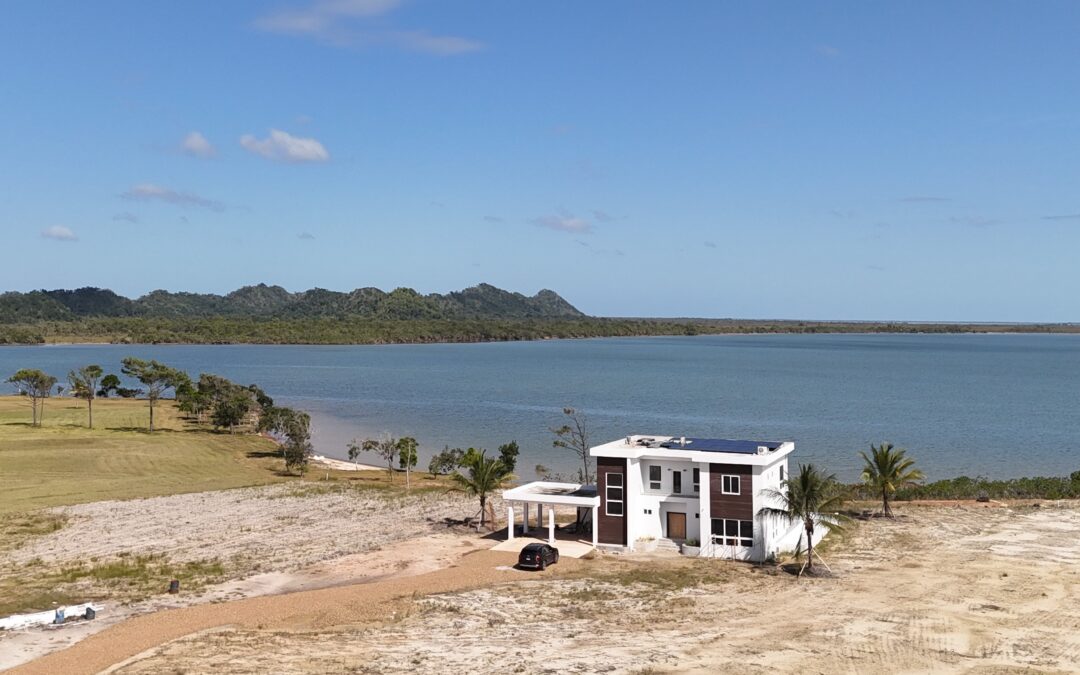
One of the clearest expressions of the concept is Coconut Point Belize, a master-planned, direct-waterfront community set on a 220-acre inland island within a 9,000-acre nature sanctuary. The location is designed as a naturally protected safe harbor, with oversized homesites and wide canals built for comfortable boating conditions, plus a cohesive plan that supports primary homes, retirement living, and short-term rental investment.
That combination – natural shelter, direct water access, and value-protecting standards – is what many buyers are actually looking for when they type the keyword into Google. They don’t want “water nearby.” They want waterfront that behaves.
What to ask before you reserve a waterfront lot
If you’re serious about buying, your questions should get more specific as the view gets better.
Ask how the site performs when weather shifts. Not just in a major storm, but in typical seasonal wind. Ask what boating looks like on an average afternoon, not just on a calm morning tour. Ask what the plan is for keeping access reliable over time.
And ask whether the community welcomes short-term rentals and has a philosophy around them. In Belize, rental friendliness is not automatic. When it is supported, it changes the math – and it changes how confidently many owners build.
The best properties don’t only sell you the dream. They answer the boring questions with confidence.
A closing thought
If you want Belize to feel like an escape instead of a project, choose waterfront that’s protected by more than wishful thinking. When the land itself shields your shoreline and your boating, the whole experience gets quieter – and that quiet is exactly what most people are really buying.


