If you are searching for safe harbor marina lots Belize, you are already thinking like a seasoned buyer. You want the dream, yes – but you also want protection, practicality, and resale strength. Here is what actually matters when you start comparing locations, developments, and waterfront conditions.
What “safe harbor” really means in Belize
A true safe-harbor setting is about more than being “near a marina.” It is a physical advantage that shows up in daily life and in storm season.
Protected water reduces chop and surge, which makes docking easier, keeps boats cleaner, and lowers wear on lifts, pilings, and seawalls. It also makes your waterfront feel usable more days of the year – not just on calm, postcard mornings.
In Belize, that protection usually comes from geography: inland islands, mangrove buffers, natural basins, and canal systems that sit behind the immediate coastal exposure. The trade-off is that the more protected you are, the more you need to verify navigability – depth, bridge clearance, and how quickly you can reach open water.
Safe harbor is also about planning. In a well-designed waterfront community, the waterways are engineered for turning radiuses, controlled boat speeds, and predictable access, not improvised after the fact.
Marina lots vs canal-front vs bayfront: the differences that change your lifestyle
“Marina lot” can mean several things. Sometimes it means you are adjacent to a communal marina basin. Other times it is used loosely to describe any water-access property.
Canal-front lots are often the sweet spot for buyers who want private docking. Your boat is at home, your gear stays close, and your day on the water starts without a drive. The key is canal width and layout. Narrow canals can feel intimate until you are trying to turn a larger boat or handle a crosswind.
Bayfront lots deliver open views and a more dramatic sense of arrival. They can also be more exposed. Depending on the coastline and prevailing winds, bayfront can mean bigger water, stronger breezes, and more salt spray. That can be a fair trade if your priority is horizon views and you accept more weather influence.
A true marina-adjacent lot can offer community convenience – services, fuel access, social energy – but it may also come with more traffic, more noise, and less privacy. The right choice depends on whether you want “resort marina” vibes or private, residential calm.
The make-or-break detail: protected boating conditions you can actually use
Safe harbor matters because it protects your boat and your time. But you also need the area to function like a boating lifestyle, not just look good on a site plan.
Ask practical questions early. Are the waterways wide enough for stress-free navigation? Do you have direct-waterfront access at your homesite, or is docking shared? Is there a clear, dependable route to prime fishing, reefs, and day-trip destinations? If you plan to keep a boat long-term, the difference between “possible” and “pleasant” adds up quickly.
And remember that protected water is not only about storms. It is about ordinary days: afternoon winds, wake management, and how comfortable it feels to step onto your dock with kids, guests, or groceries.
Ownership and use: what you can do with the property matters as much as the view
Belize is famously friendly to foreign buyers, but “friendly” does not mean “identical to back home.” Before you commit to any waterfront lot, align the ownership structure with your goals.
Some buyers want a second home they can lock and leave. Others want a retirement plan with the option to rent seasonally. Investors may want short-term rental flexibility from day one. Those outcomes require clarity on community rules.
A development with balanced building standards can be a major advantage. Standards protect your upside by preventing the neighborhood from drifting into mismatched construction, neglected lots, or piecemeal development that hurts values. The trade-off is that standards should feel protective, not restrictive. You want guidelines that keep the community cohesive without forcing a cookie-cutter result.
If vacation rentals are part of your plan, do not assume they are allowed. Many waterfront communities limit short-term rentals to preserve a quiet feel. That can be good for some owners and a dealbreaker for others. You should know the policy before you buy, not after you design your house around rental income.
Access is value: airport proximity changes your real-world usage
Waterfront property can be spectacular and still sit unused if it is difficult to reach. For US and Canadian buyers, ease of access is not a luxury – it is what turns a “someday” dream into something you actually enjoy multiple times a year.
Look at drive time from the international airport, road quality, and how predictable the trip is in different seasons. A location that is roughly 45 minutes from the airport via Belize’s Coastal Highway can radically change how often you visit, how easily guests come, and how practical it is to manage a rental.
Access also affects your contractor experience during the build. Materials, labor, and supervision are simpler when the site is not a multi-hour trek with uncertain timing.
The hidden strength of a master-planned waterfront community
A scattered waterfront market can deliver deals, but it also creates uncertainty: neighboring uses can change, infrastructure can be inconsistent, and resale comparisons can be messy.
A master-planned community introduces predictability – roads, drainage, utilities planning, security, and a coherent vision that creates long-term demand. For safe harbor waterfront in Belize, the planning matters even more because the waterway design becomes part of your daily life.
If you find a community built on an inland-island concept within a large nature sanctuary, that can create a rare combination: privacy and protected water, with a sense of arrival that feels exclusive rather than isolated. It is also a stronger story for future buyers and renters – and story matters in lifestyle real estate.
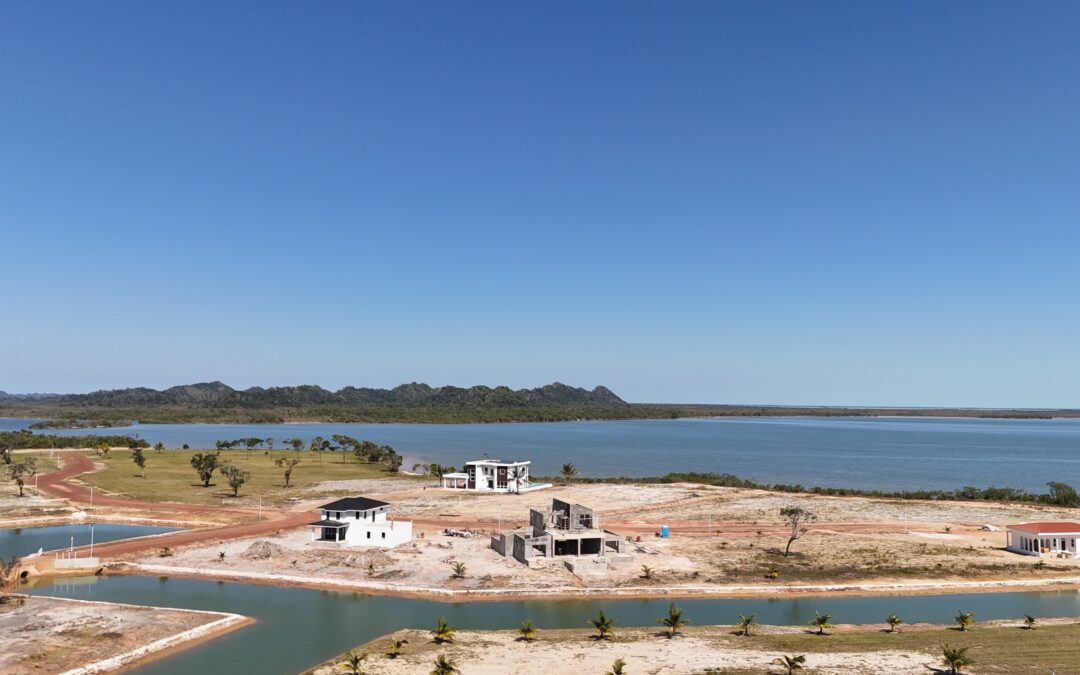
One example is Coconut Point Belize, a 220-acre inland island connected by a land bridge and set within a 9,000-acre nature sanctuary, designed around direct-waterfront homesites with protected boating conditions and a community plan that supports building, living, and short-term rentals.
What to verify before you reserve a lot
You do not need to become a marine engineer to buy well, but you do need to be precise. The most expensive regrets usually come from assumptions.
Start with the water itself. Ask about typical depths and how they are maintained. Confirm canal width – wide canals are not just a bragging right; they affect maneuvering, wake comfort, and long-term usability. Ask how tidal variation affects access.
Next, confirm the development timeline. Phased communities can be a smart way to build momentum and protect pricing. The trade-off is patience: later phases may mean you are buying into what the community is becoming, not only what it is today. If Phase 1 is sold out and Phase 2 is underway, that is a signal of real demand, but you still want to understand what amenities are planned, when they are expected, and how they support property values.
Then clarify utilities and infrastructure. Waterfront beauty does not replace dependable power, water, and internet – especially if you plan to work remotely or operate a rental.
Finally, get clear on the building path. Many buyers prefer a guided process with recommended architects and contractors. That guidance reduces risk, speeds up decisions, and keeps the finished homes aligned with the community’s standards.
Investment upside – and the honest trade-offs
Belize draws lifestyle buyers, and lifestyle demand supports rentals. Add investor-friendly fundamentals like low property taxes and no capital gains tax, and the long-term math can look compelling. But smart buyers still run the “it depends” scenarios.
Rental performance depends on access, design, and local demand. A protected safe-harbor location can be a real differentiator for guests who want boating, paddleboarding, or calm-water views – but only if your home is built to the standard that travelers expect.
Resale strength depends on scarcity and cohesion. Direct-waterfront inventory in a secure, planned community is naturally limited, and that limitation can support pricing. The risk is buying somewhere without consistent standards or without a believable plan for ongoing enhancement. If the area around you can change unpredictably, your future buyer will price in that uncertainty.
And while safe harbor reduces exposure, every coastal market has climate considerations. You are not trying to eliminate nature. You are choosing a setting designed to live with it intelligently.
Choosing the right lot comes down to your version of “Caribbean living”
Some buyers want the social energy of a marina hub. Others want a quiet canal where mornings are still and the only traffic is a heron crossing your view. Some want bayfront drama. Others want protected calm and the confidence of stepping onto the dock without thinking twice.
If you are serious about safe harbor marina lots Belize, treat the search like a blend of romance and underwriting. Fall for the water, absolutely – then verify the protection, the access, the rules, and the plan. The best lots are not the ones that look perfect online. They are the ones that keep feeling easy, year after year, long after the novelty wears off – when it is just you, your boat, and the kind of quiet that makes you wonder why you waited so long.


